
Maintenance, How-To, Outboard Motors, Winterizing
How to Winterize a 4-Stroke Outboard: Step-by-Step Guide
Oct
Table of Contents
How to winterize a 4 stroke outboard
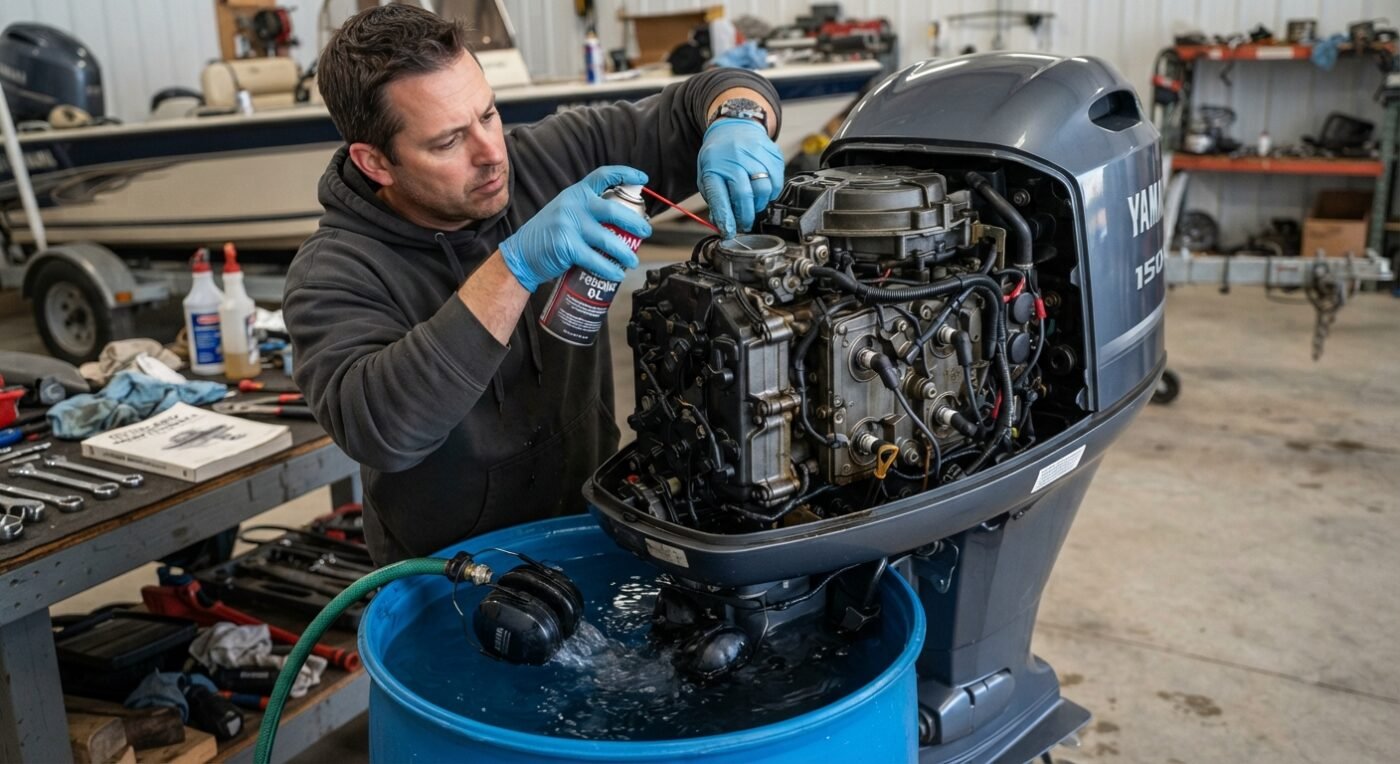
To winterize a 4-stroke outboard, treat the fuel and run it through the engine, flush the cooling system, fog the cylinders, change the engine oil and filter, replace the lower-unit gear lube, check the anodes and grease points, and store the motor upright and covered. The steps are the same across brands. The parts that change are how much fuel to leave in the tank, how to fog, and what your manual says about storage, so we flag those as we go.
Do you need to winterize your outboard?
If the motor will sit through freezing weather, yes. Water left in the lower unit or cooling passages can freeze, expand, and crack housings. The Marine Gear Depot Service & Rigging Team sees this most with water-contaminated gear oil, which they say can separate, freeze, and split the lower unit housing.
If you live where it doesn’t freeze, you still have a fuel problem. Honda says gasoline sitting in a float bowl or a part-filled tank for as little as 30 to 60 days can cause starting problems, and it treats storage over 30 days as the point to add a gasoline conditioner. A boat that sits for a couple of months should get the fuel, oil, and gear lube steps even if no ice is coming.
What goes wrong when a motor isn’t winterized?
The Service & Rigging Team says boats rolling in for spring recommissioning usually fail in four ways:
- Clogged carburetors. Untreated fuel sits in the carburetor all winter and turns to varnish that plugs the jets. A motor that stalls or idles rough in spring is the classic sign.
- Milky gear oil. Water gets past the prop shaft seals and mixes with the lower-unit oil. Over winter it can freeze and crack the housing.
- Stuck thermostats. Salt, sand, and mineral deposits can harden while the motor sits dry. A thermostat stuck open means the engine won’t warm up. Stuck closed, it overheats on the first trip.
- Corrosion on the cylinder walls. Moisture can surface-rust the cylinders and lock piston rings.
What you’ll need
| What | Why | From us? |
|---|---|---|
| Flusher (ear muffs) and a garden hose | Flush and run the engine on fresh water | Yes: Outboard Motor and Z-Drive Flusher / round |
| 4-stroke marine engine oil | Fresh oil for storage | Yes: Marine 4T Motor Oil 10W-30 / 5 L |
| Oil filter and drain plug gasket | Replace with the oil | Model-specific: look up your engine’s part numbers |
| Fuel stabilizer | Keeps stored fuel from going stale | Currently out of stock. Look for one labeled for ethanol blends and long-term storage. |
| Fogging oil | Protects cylinders from rust | Currently out of stock. Look for a marine storage fogging oil, and for fuel-injected engines check whether your manufacturer wants an EFI-specific one. |
| Gear lube and a gear lube pump | Replace the lower-unit oil | We don’t stock it. Use the type your manual specifies, plus new gaskets or washers. |
| Anodes | Replace if worn | Yes, for specific models: Zinc Motor Anode Set / F30, F40 and F60 . Check the listing for your exact brand and model. |
| Marine grease | Fill the grease fittings | Use the grease your manual specifies |
| Outboard cover | Keep dust and moisture off | Yes: Outboard Covers |
You’ll also want a drain pan, sockets, a spark plug socket, and rags. For a first-timer, winterizing an typically takes between 1.5 to 3 hours
How do you winterize a 4-stroke outboard, step by step?
Do these in order. The first three happen with the engine running on the flusher, so set up near a hose, outdoors, with the prop clear. Before you start, check that your manual allows running the engine on a flusher. Some small portables are air-cooled and have no water pump to flush. The Honda BF2.3 is one.
Step 1: Treat the fuel
Fresh fuel treated with a stabilizer is the standard approach. How much fuel to leave in the tank depends on the brand, so check this against your manual:
- Yamaha says to store the tank 7/8 full to limit condensation, and never to plug or cap the tank vent.
- Honda says that if the motor will sit more than 60 days, completely drain the fuel system and the tank.
- A Mercury dealer lead suggests running the tank nearly empty first, then adding fresh fuel and the right amount of stabilizer.
Our BENZIN Plus fuel additive is a fuel additive that raises octane and helps keep deposits from forming. Don’t use it as the only step. Use the stabilizer your engine maker recommends.
Step 2: Flush and run the treated fuel through
Connect the flusher to the lower unit, turn the water on, then start the engine. Never run it without water. Keep it in neutral and keep hands clear of the prop. Run it for the time in your manual or on the stabilizer label. Among the manufacturers we checked, the figures ranged from about 5 to 10 minutes.
The check that it worked: a steady stream of water from the engine’s water-check outlet. Then shut it off and disconnect the flusher.
Step 3: Fog the cylinders
Fogging oil coats the cylinder walls, rings, and valves to stop rust. The method depends on the brand:
- Mercury says to fog four-strokes while the motor is still warm by removing the spark plugs and spraying fogging oil into each cylinder, using a product made for winterizing. It also suggests putting anti-seize on the plug threads when you reinstall them.
- Yamaha says to use an EFI fogging oil on most modern fuel-injected four-strokes. For its larger engines it describes running treated fuel and fogging oil from a portable tank.
- Suzuki’s storage procedure for its larger four-strokes doesn’t list fogging at all.
Don’t assume the method from an older carbureted engine applies to an EFI engine. If you skip fogging, some technicians instead start the motor every few weeks. Note that this needs water for the cooling system each time, so it doesn’t work for a motor in freezing storage.
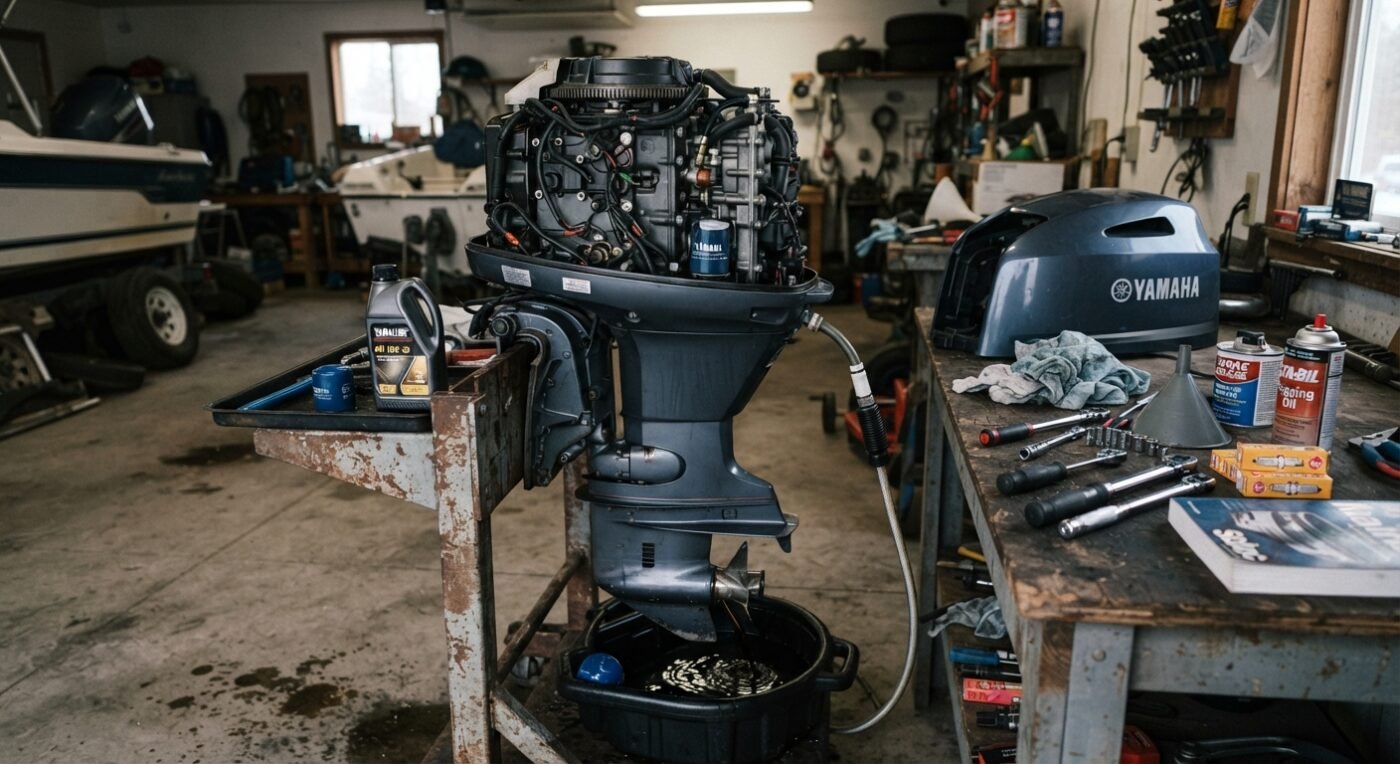
Step 4: Change the engine oil and filter
Do this while the engine is warm. Drain the old oil, replace the filter and drain plug gasket, then refill to the level your manual specifies. Yamaha also says to change the onboard 10-micron fuel filter, since any water in the canister can freeze.
The check that it worked: the dipstick reads correctly and nothing is leaking at the filter or drain plug. Used oil goes to a recycling point, not the bin.
Step 5: Change the lower-unit gear lube
This applies to four-strokes too. Open the drain and vent plugs and look at the oil as it comes out. Milky or watery oil means water has got in past a seal, so fix it before spring. Refill from the bottom port until fresh oil comes out of the vent port, then fit new gaskets.
Step 6: Check anodes, grease the fittings, inspect
Look at the anodes. A common guideline is to replace them when about half is gone. Grease every fitting your manual lists. Yamaha notes that fresh grease helps push out water that has collected in them. Then look the engine over from the cowling to the skeg, and take the prop off to check the shaft for fishing line.
Step 7: Charge the battery and bring it indoors
Charge it fully and store it somewhere cool and dry. Yamaha recommends checking the charge monthly and not leaving the battery to freeze outside.
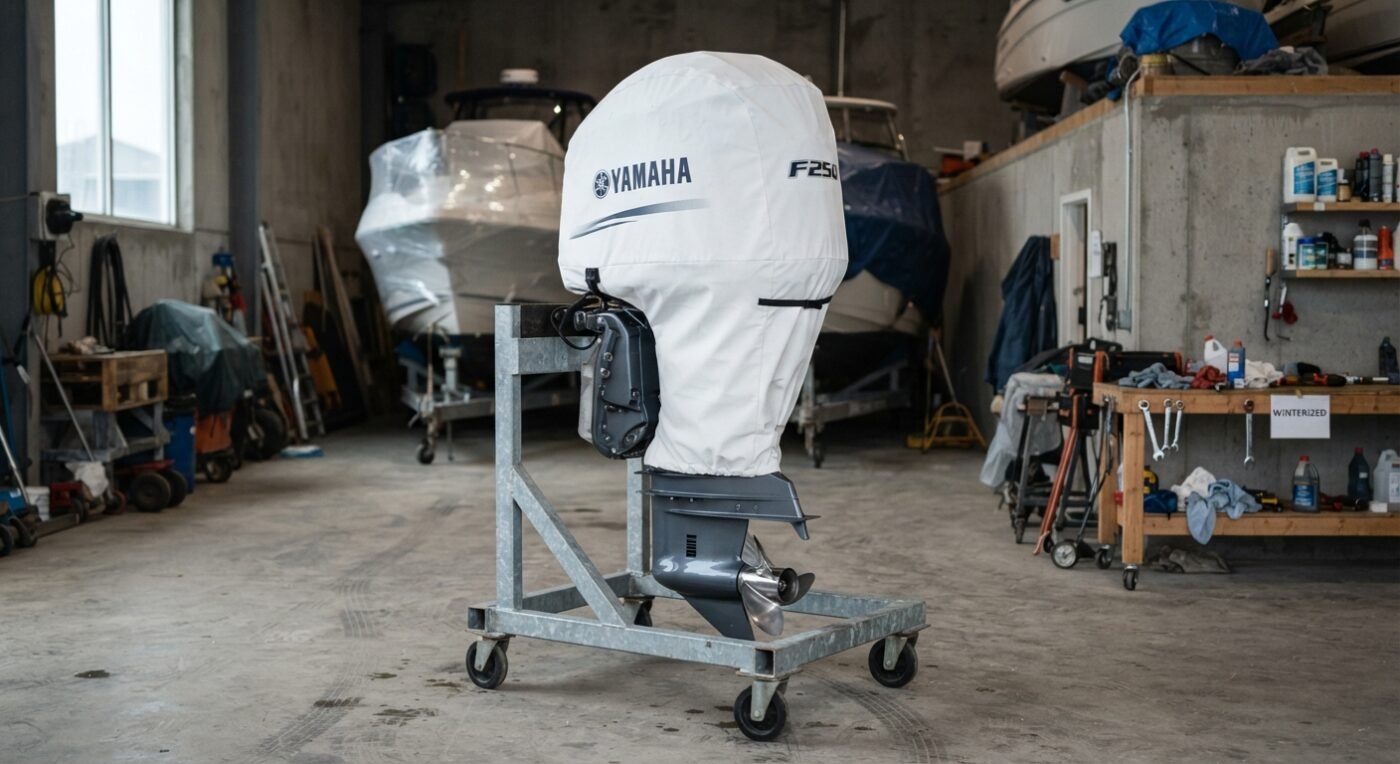
Step 8: Store it upright and covered
Honda recommends storing the motor in its standard operating position. If it stays outdoors in cold weather, Yamaha suggests trimming it fully in to a negative angle, or sealing a bag over the dry lower unit, so water can’t collect and freeze.
Use a cover that lets air through. A sealed one traps condensation. Our outboard covers listing describes a coated polyester cover with a soft inner lining, an elastic hem, and drawstrings.
How do the brands differ?
These come from each manufacturer’s own storage guidance. Your manual is the final word.
| Brand | Fuel | Fogging | Other notes |
|---|---|---|---|
| Yamaha | Stabilize and circulate; store 7/8 full; never cap the vent | EFI fogging oil for most modern fuel-injected four-strokes | Change the 10-micron fuel filter; cold storage: negative trim or a bag over the lower unit |
| Mercury | Fresh fuel with stabilizer; a dealer lead suggests running the tank low first | Spark plug holes, motor warm, winterization fogging oil | Anti-seize on plug threads |
| Honda | Conditioner for storage over 30 days; drain the fuel system if over 60 days | Light oil film on rust-prone surfaces | Store in the standard operating position |
| Suzuki | Stabilizer, then run it through | No fogging step in the larger-engine procedure we found | Rust preventative on the powerhead; follow your model’s manual |
Boat winterizing checklist (outboard edition)
Tick these off in order. This covers the outboard side only. Plumbing, hull and trailer steps depend on your boat, so check yours.
- Add stabilizer to fresh fuel, per your manual
- Flush and run the treated fuel through the engine
- Fog the cylinders, using your engine’s method
- Change the engine oil and filter
- Change the onboard fuel filter, if your manual calls for it
- Drain and replace the lower-unit gear lube; check for water
- Inspect and replace worn anodes
- Grease every fitting your manual lists
- Inspect the engine and prop
- Charge the battery and store it indoors
- Store upright and fit a ventilated cover
What are the common mistakes?
- Adding stabilizer but not running it through. It has to reach the carburetor or injectors, so run the engine.
- Fogging an EFI engine the carburetor way. Check your manual’s method first.
- Skipping the gear lube because it’s a four-stroke. Gear lube applies to every outboard, and water in it is the usual cause of a cracked housing.
- Capping the fuel tank vent. Yamaha warns this can damage tanks and fittings.
- Covering the motor with something airtight. It traps condensation.
- Running without water, or in gear. Water first, neutral, hands clear.
When should you take it to a shop?
If the gear oil comes out milky or with metal in it, if you can’t get a steady water stream while flushing, or if the manual’s steps are beyond your tools, a dealer can do the job. The Service & Rigging Team can spot unrelated problems while they’re in there.
FAQ
Do you have to winterize a 4-stroke outboard?
If it freezes where you store it, yes. If it doesn’t, the fuel, oil, and gear lube steps still matter once the motor sits for a month or two.
Is fogging necessary on a four-stroke?
Most manufacturers recommend it, but methods differ, and Suzuki’s procedure for its bigger engines doesn’t list it. Follow your manual.
Can I leave fuel in the tank over winter?
It depends on the brand. Yamaha says to store it 7/8 full with stabilizer, and Honda says to drain it after 60 days. Check your manual.
Should I put antifreeze in a four-stroke outboard?
None of the manufacturer storage guides we checked call for it. Don’t add any unless your manual says to.
Can I lay the outboard down for storage?
Check your manual for which side it can rest on. Laying it the wrong way can let oil drain into places it shouldn’t.
how to winterize a 4 stroke outboard
